Monday, May 7, 2018

Father Angelus de Revillagodos

Father Angelus de Revillagodos became the founding pastor of Ascension church at Valenzuela. He got his appointment from the Bishop of Cuba, Rev James Joseph de Echeverria on June 16th, 1772 to serve in Louisiana under Governor Unzaga. Along with Father Luis Lipiano de Tolosa and Fr. Luis de Quintanilla, Fr. Revillagodos arrived at a time when the church was struggling to maintain control of formerly French speaking populations.  Fr. Lipiano replaced Fr. Valentin due to clashes with Acadians at St. James, Fr. Quintanilla was assigned to "moral reform" at the northwestern frontier of Natchitoches.9  

Fr. Revillagodos arrived on July 19th, 1772 in New Orleans alongside Capucihin Fray Cyril de Barcelona and were "well received by the Spanish authorities".3,4,8  According to historical records, "Father Dagobert, leading the French Capuchins, and followed by a large crowd, went in a procession to the levee. Standing in front of the "Place d'Armes" the new comers were received with due honors and great demonstrations of joy. The next day they were formally introduced to Governor Unzaga. Father Cyril then presented his credentials from the bishop, whereupon the Governor expressed his willingness to carry into execution the mandates of his superior, the Bishop of Cuba."1,8  

They traveled to the area which at the time was known as Lafourche de Chitimachas and declared the new parish "The Ascension of Our Lord". Sent by the King, his purpose was to "minister to the spiritual welfare" of the community.6  The first church along Lafourche was founded on August 15th, 1772 and became an integral part of welcoming the first Islenos in 1779. Legend has it that Valenzuela was born amidst dancing and feasting.5   Because of “good times,” on Christmas 1779, the Islenos held a large celebration with Ascension's Father Angelus de Revillagodos marrying six couples and baptizing two infants. By 1773, he was assisting the parish of St. Gabriel up the river and continued to do so until 1782.7  In 1781, he helped oversee a new church in Ascension.

During these years, Fr. Revillagodos and Comandant Louis Judice didn't always agree. Judice suffered from alchoholism, indigence, and poor adminstration. Many priests in his territories ended up leaving. Given his conservative nature, Fr. Revillagodos also found himself embroiled with the French Acadian population and their customs. In 1776, while standing at the altar of the church, he prohibited all of his female parishioners from utilizing the services of Madame Desire LeBlanc, who had served as midwife for 22 years. Leblanc and her husband filed a complaint with Judice. Gov Unzaga overruled Revillagodos.

With the Ascension church far enough away from most Islenos, Fr. Revillagodos occasionally visited the Islenos in their own settlement for baptisms, marriages, and burials. During the building of the new church, Fr. Revillagodos received an unexpected departure notice in 1782 to serve Natchez for about a year. Although he asked to remain there, in 1783 he resumed his duties in Ascension.

Fr. Revillagodos, perhaps the first Spanish Capuchin to administer a parish in Louisiana, died in the church rectory in December 1784 after serving Ascension for a dozen years.2  It's been said that he died of grief brought on by Judice.5  The following year, he was replaced by Capuchin Father Joaquin de Ajofrin and then by Capuchin Father Pedro de Zamora. Today, many of our Isleno ancestors from Valenzuela and Galveztown had religious sacraments performed by Fr. Revillagodos.


  1. In and around the old St. Louis Cathedral of New Orleans By Celestin M. Chambon
  2. Baudier, The Catholic Church in LA, 184, 203-05, 235; BRDR, vol. 2
  3. https://www.catholic.org/encyclopedia/view.php?id=10809
  4. Life And Times Of The Most Rev. John Carroll, Bishop And First Archbishop Of Baltimore: Embracing The History Of The Catholic Church In The United States 1763-1815 by John Gilmary Shea
  5. Canary Islanders of Louisiana by Gilbert Din
  6. The WPA Guide to Louisiana: The Pelican State By Federal Writers' Project
  7. http://www.stgabrielcatholicchurch.com/history/st-gabriel/
  8. History of Louisiana: the Spanish domination by Charles Gayarré
  9. LUIS DE QUINTANILLA Y LUIS LIPIANO. Archivo General de Indias, CONTRATACION,5517,N.1,R.9


Tuesday, October 24, 2017

Jose Tilano & Micaela Reyes

Name: Jose Tilano
Ship: La Victoria
Residence: Aguimes, Gran Canaria

Wife: Micaela Reyes (Padilla)
Residence: Aguimes, Gran Canaria


History

Jose left Santa Cruz, Tenerife in Oct 22, 1778, sailing on La Victoria and landed in New Orleans on Jan 14, 1779 with his wife Micaela and children Juan, Jose, Gaspar, Augustin, and Maria.[1]   He arrived at the Galveztown settlement.

Jose is listed in the libro maestro, likely receiving rations in Galveztown in 1779.[18]   On July 16, 1782, he is shown listed in another list receiving raciones (rations).[19]  

Micaela's name can be found spelled "Micaela Padilla" and "Migula Aparillo" in the marriage investigation of her son in 1803 and "Miguela Pretolina" in the baptism of son Augustin Miguel.[2,6]   Jose is often listed as "Juan" in several records.   She died before 1785.  


1794 Galveztown Survey
Children

  1. Juan (b. 1766)
  2. Jose Antonio (b. 1769)
  3. Gaspar (b. 1772)
  4. Agustin (b. 1775)
  5. Maria (b. 1776)
  6. Augustin Miguel (b. 1781)


Son Juan is mentioned in US territorial claims shortly after American possession on February 8, 1804. He claims concession and measured, five arpents of land of front, with forty of depth, ascending from Galveztown, the Bayou Manchac, on the left bank, bounded on the lower part by the lands of Dn Marcos de Villiers and on the upper part by lands of Jose Ramirez.[8]   He is shown on the Galveztown Survey map owning land along Bayou Manchac, near Marcos Develiers and Josef Romero.[14] He is listed in the Galveztown census of 1804.[9] 

NOTE:  Juan Tilano is mentioned in several church records in New Orleans as early as 1796.  It's possible he lived in New Orleans with his wife Maria De La Concepcion but also had land claims in Galveztown.[17]  Further investigation is needed.

Census of 1804
Son Jose married Catalina Martinez, daughter of Jose Martinez and Maria De La O of La Gomera, in Galveztown on October 5, 1803. Jose is listed as "Joseph Martin" and Maria is listed as "Maria de Lapo".[2]   They continued to have children in the Galveztown settlement.  He is listed in the Galveztown census of 1804.[9]   By 1805, they moved to "Spanish Town in Baton Rouge" and continued to have children.[3,10]  Catalina died and was buried in 1833 at St. Jospeh Cathedral in Baton Rouge, Louisiana.[16]  

"Spanish Town"
Distrito de Baton Rouge, 1805
Son Gaspar married Ana Diaz, daughter of Bartolome Diaz and Josefa Hidalgo, both from Aguimes, Gran Canaria.[2,6,13]   Josefa is also listed as "Josepha Pavona".  Their marriage investigation occurred on Feb 3rd, 1803 in Galveztown.[6,13]   Their marriage date is listed as Feb 7th, 1803. By 1805, they moved to "Spanish Town" in Baton Rouge and continued to have children.[3,4,10]   He died and was buried March 10, 1844.[15]  

Son Augustin Miguel was born August 6, 1781 and baptized in 1783 at the Galveztown settlement.[5,11]  He is mentioned that he "died at the age of 12" and was buried April 10, 1795 at the Galveztown settlement.[12]  

-----------------------------
Jose married his second wife Ana Alegria.  She was buried on November 15th, 1785 in Galveztown.[7,11] Jose married his third wife, Maria Morales, daughter of Josef from El Carrizal, Gran Canaria in Galveztown on February 25, 1792.[2]  

By 1803, Jose was no longer in Galveztown. He was "absent in the city of Havana".[6] 


Children

  1. Juan (b. 1792)
  2. Maria de la Concepcion (b. 1793)

Son Juan was born September 3, 1792 and baptized September 3, 1792 in the Galveztown settlement.   He died "1/2 hour after birth" on September 3, 1792.[2]  

Daughter Maria de la Concepcion was born November 21, 1793 and baptized November 26, 1793 in the Galveztown settlement[2].  


References

  1. Gilbert C. Din, The Canary Islanders of Louisiana, Louisiana State University Press, p220, University of Louisiana at Lafayette Edith Garland Dupre Library, PO Box 40199, Lafayette LA 70504.
  2. Diocese of Baton Rouge Church Records.  Vol 2.
  3. Diocese of Baton Rouge Church Records.  Vol 3.
  4. Diocese of Baton Rouge Church Records.  Vol 4.
  5. St. Bernard Parish Church, Galveztown, LA, GAL-BMF 1783-1803.  GAL-BMF 4-22
  6. St. Bernard Parish Church, Galveztown, LA, GAL-BMF 1783-1803.  GAL-BMF 59 to 65-129
  7. St. Bernard Parish Church, Galveztown, LA, GAL-BMF 1783-1803.  GAL-BMF 17/18-69
  8. Iberville County Louisiana Archives Court. Governors Of Galveztown, Et Al  February 8, 1804.  Record of the lands conceded by the Governors to the inhabitants of this District of Galveztown, with description of the arpents which they possess.
  9. "Registro de las Tierras Concedidas por los Señores Govennadones à los abitantes de este Districto de Galveztown con èxpression de los àrpanes que cadauno tiene febr. 8th 1804". Conveyance Book B, May 3, 1787 - January 30, 1804.  Iberville Parish Courthouse, Plaquemine, LA
  10. "Florida Occidental, Distrito de Baton Rouge, año de 1805".  Cadastral map. 1805.  Pintado, Vicente Sebastián.  Library of Congress Geography and Map Division Washington, D.C.  G4014.B3G46 1805 .P5
  11. Sacramental Records of the Roman Catholic Church of the Archdiocese of New Orleans.  Vol. 4
  12. Sacramental Records of the Roman Catholic Church of the Archdiocese of New Orleans.  Vol. 5
  13. Sacramental Records of the Roman Catholic Church of the Archdiocese of New Orleans.  Vol. 7
  14. Surveyors Maps of the District of Galveston, Louisiana. 1793-1794.  Box 3e487, Folder 4
  15. Diocese of Baton Rouge Church Records.  Vol 6.
  16. Diocese of Baton Rouge Church Records.  Vol 5.
  17. Sacramental Records of the Roman Catholic Church of the Archdiocese of New Orleans, vol. 6
  18. "Yndice de las familias Yslenas qe. han de establecer la Nueva Poblacion de Galveztown, Año de 1779" No. 1, Libro Maestro, Archivo General de Indias. Papeles de Cuba, Legajo 568. 
  19. Untitled document from St. Maxent listing those receiving rations, July 16, 1782. Archivo General de Indias. Papeles de Cuba, Legajo 568. Referred to by researchers as the "Ramirez List".

Monday, October 23, 2017

Tomas Collado & Maria Aleman


Name: Tomas Collado
Ship: La Victoria

Wife: Maria Aleman

History

Tomas left Santa Cruz, Tenerife in Oct 22, 1778, sailing on La Victoria and landed in New Orleans on Jan 14, 1779 with his wife Maria and sister Maria.[1]   He arrived at Terre-Aux-Boeuf settlement and was listed in the libro maestro of 1779.  By 1783, he arrived at the Galveztown settlement.  


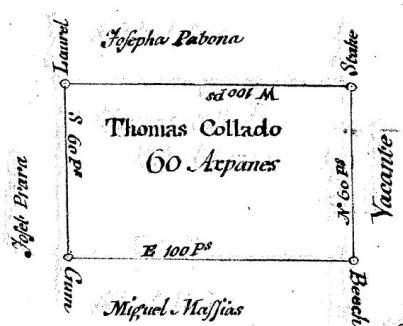
Tomas owned land along Bayou Manchac, near Josefa Pabona, Miguel Massias, and Josef Pererra.[18]   His name is spelled Thomas Collado in the 1794 survey.[18]  
Galveztown Survey

Thomas Collado claims concession and thereon measured ten arpents of land of front, with six of depth in February of 1794, bounded on the north by land of Jossefa Parona, and on the south by lands of Miguel Masias and Felipe Romero.[7] 

In 1803, Tomas continued to reside in Galveztown on the corner of Royal St and Houmas St, west of Juan Aleman and south of William Yarabrough.[12]  In 1804, shortly after American possession, Tomas is mentioned in US territorial claims.  Tomas and his family claimed land both along Bayou Manchac, west of the Galveztown settlement as well as land in "Spanish Town".[10]  

Tomas was shown on the Galveztown census on Feburary 8th, 1804.[8]  
Census of 1804
NOTE: He is also is listed in land claims made in 1832 represented in a township map.[11] These claims could possibly represent his son, Thomas Antonio.

Tomas' wife Maria died on May 3, 1819 and buried in New Orleans, Louisiana.[15]  

Tomas' sister Maria married Juan Benitez, spelled "Benitos".  She died November 29, 1797, at age 46, and buried in New Orleans.[14]  

Children

  1. Josefa Francisca (b. 1783)
  2. Agustina Josefa (b. 1785)
  3. Thomas Antonio (b. 1786)
  4. Rosa Agustina (b. 1787)
  5. Josepha Cunegunda (b. 1789)
  6. Juana Tomasa (b. 1791)
  7. Santiago de la Mancha (b. 1792)
  8. Maria (b. )

Daughter Josefa Francisca was born July 24, 1783 in Galveztown and baptized August 7, 1783 at the St. Gabriel Catholic Church in St. Gabriel, Louisiana.[2,4]  

Daughter Agustina Josefa was born April 9, 1785 in Galveztown and baptized July 10, 1791 at the St. Gabriel Catholic Church in St. Gabriel, Louisiana.[2]  
Distrito de Baton Rouge, 1805

Son Thomas Antonio was born April 26, 1786 in Galveztown and was baptized on October 3, 1786 at the St. Gabriel Catholic Church in St. Gabriel, Louisiana.[2,5]  He (maybe his father?) moved to Baton Rouge's "Spanish Town" district in 1805 next to Diego Quintana and Francisco Perera.[10]  Santiago died on December 22, 1842.[13,19]  

Daughter Rosa Agustina was born August 22, 1787 in Galveztown and baptized September 3, 1787 at the St. Gabriel Catholic Church in St. Gabriel, Louisiana.[2]  

Daughter Josepha Cunegunda was born in Galveztown and baptized August 2, 1798 at the St. Gabriel Catholic Church in St. Gabriel, Louisiana.[2]  

Daughter Juana Tomasa was born September 1791 in Galveztown and baptized September 22, 1791 at the St. Gabriel Catholic Church in St. Gabriel, Louisiana.[2]  

Son Santiago de la Mancha was born November 27, 1792 in Galveztown and baptized December 2, 1792 at the St. Gabriel Catholic Church in St. Gabriel, Louisiana.[2]  By 1830, he resided in St. Bernard, Louisiana and is listed in the 1830 and 1840 census.[16,17]  

Daughter Maria married Diego Quintana, son of Joseph Angel de Quintana and Agustina Monson of Telde, Gran Canaria, in Galveztown, with the marriage recorded on January 7, 1797 at the St. Gabriel Catholic Church in St. Gabriel, Louisiana.  They are listed in the marriage investigation on December 30th, 1796.[2,6,9]  

References

  1. Gilbert C. Din, The Canary Islanders of Louisiana, Louisiana State University Press, p220, University of Louisiana at Lafayette Edith Garland Dupre Library, PO Box 40199, Lafayette LA 70504.
  2. Emilie G. Leumas, archivist, Diocese of Baton Rouge Catholic Church Records, Department of Archives, v2.
  3. Emilie G. Leumas, archivist, Diocese of Baton Rouge Catholic Church Records, Department of Archives, v3. 
  4. St. Bernard Parish Church, Galveztown, LA, GAL-BMF 1783-1803.  GAL-BMF 6-34
  5. St. Bernard Parish Church, Galveztown, LA, GAL-BMF 1783-1803.  GAL-BMF 9-47
  6. St. Bernard Parish Church, Galveztown, LA, GAL-BMF 1783-1803.  GAL-BMF 49-111
  7. Iberville County Louisiana Archives Court. Governors Of Galveztown, Et Al  February 8, 1804.  Record of the lands conceded by the Governors to the inhabitants of this District of Galveztown, with description of the arpents which they possess.
  8. "Registro de las Tierras Concedidas por los Señores Govennadones à los abitantes de este Districto de Galveztown con èxpression de los àrpanes que cadauno tiene febr. 8th 1804". Conveyance Book B, May 3, 1787 - January 30, 1804.  Iberville Parish Courthouse, Plaquemine, LA
  9. Sacramental Records of New Orleans, Vol 6. p.60, p.229
  10. "Florida Occidental, Distrito de Baton Rouge, año de 1805".  Cadastral map. 1805.  Pintado, Vicente Sebastián.  Library of Congress Geography and Map Division Washington, D.C.  G4014.B3G46 1805 .P5
  11. Township Survey of 1832.  John Gilmore. "Southeastern District of Louisiana.  East of the Mississippi River."  T.8S R.3E. Redrawn in 1871. Published 1882.  Survey General's Office, New Orleans, LA
  12. Description of lots in Galveztown from American State Papers. 1803.
  13. "Louisiana, Orleans, Death Records and Certificates, 1835-1954", , FamilySearch (https://www.familysearch.org/ark:/61903/1:1:Z4SG-5LZM : Fri Mar 08 00:26:45 UTC 2024), Entry for Santiago Collado and Santiago Collado, 22 Dec 1842.
  14. "Louisiana, State Museum Historical Center, Cemetery Records, 1805-1944", , FamilySearch (https://www.familysearch.org/ark:/61903/1:1:6ZL2-JK8G : Sun Mar 10 16:06:25 UTC 2024), Entry for Maria Callado and Juan Benitos, 29 Nov 1797.
  15. "Louisiana, State Museum Historical Center, Cemetery Records, 1805-1944", , FamilySearch (https://www.familysearch.org/ark:/61903/1:1:6ZLT-XDVJ : Sun Mar 10 05:52:55 UTC 2024), Entry for Marie Collado and Thomas Collado, 3 May 1819.
  16. "United States, Census, 1830", , FamilySearch (https://www.familysearch.org/ark:/61903/1:1:XHP1-KHG : Sat Mar 09 03:56:37 UTC 2024), Entry for Sntiagao Collado, 1830.
  17. "United States, Census, 1840", , FamilySearch (https://www.familysearch.org/ark:/61903/1:1:XHTD-5TR : Mon Apr 29 18:24:50 UTC 2024), Entry for Santiago Collado, 1840.
  18. Surveyors Maps of the District of Galveston, Louisiana. 1793-1794.  Box 3e487, Folder 4
  19. "Orleans, Louisiana, United States records," images, FamilySearch (https://www.familysearch.org/ark:/61903/3:1:S3HT-6S77-4M2?view=index : Jan 18, 2025), image 790 of 885; New Orleans (Louisiana). City Archives.

Thursday, January 14, 2016

Introduction

TBD


Note to genealogists:  Do not reference the individual blog page as your source.   Be sure to use the references at the bottom of each article as your reference instead.  Verify each one for accuracy.