Showing posts with label Barataria Settlement. Show all posts

Tuesday, February 4, 2025

Juan Alvarado & Maria Suarez

Name: Juan Alvarado
Ship: San Ignacio de Loyola 

Wife: Maria (Mata) Suarez

History

Juan left Santa Cruz, Tenerife in 29 Oct 1778 sailing on the San Ignacio de Loyola and landed in New Orleans on Jan 9, 1779 with his wife Maria and children Tomas, Isabel and sister-in-law, Francisca Antonia.[1] The family arrived at the Barataria settlement by July 20, 1779. 

The Barataria settlers suffered great hardships and many requested to leave for other nearby Isleño settlements in Louisiana.  Juan and his family were living in Barataria receiving raciones (rations).[5]  By December 1779, the family left Barataria and resided at the Valenzuela settlement.   On December 15, 1779, Juan is listed in the Valenzuela libro maestro / cargo list index receiving raciones (rations).[6]  

Maria is listed as "Maria Mata" in several of her children's baptisms.[2,3]  

NOTE: Sister-in-law Francisca is not present in Valenzuela records.  She may have moved to New Orleans or St. Bernard at the Terre-Aux-Boeuf settlement where she possibly had a daughter die of small pox.[7]  Further investigation is required. 

Juan died at the age of 67 years and was buried November 8, 1816 at the Assumption of the Blessed Virgin Mary Catholic Church in Plattenville, LA.[3]  


Children

  1. Tomas (b.1774)
  2. Isabel Catharina (b.1776)
  3. Antonio (b.1780)
  4. Francisca (b. 1785)
  5. Maria (b.)
  6. Juan (b.)
  7. Francisco (b. 1792)
Son Tomas married Mercedes Rodriguez, daughter of Cristoval Rodriguez and Maria Francisca Dias, on December 20, 1797 at the Church of the Ascension of Our Lord Jesus Christ in the Valenzuela settlement.[2]  They continued to have children in the Valenzuela settlement.  He died 

Daughter Isabel Catharina married Vicente Fernandez, son of Barolome Fernandez and Catarina Misebes(?), on  December 29, 1794  at the Assumption of the Blessed Virgin Mary Catholic Church in Plattenville, LA.[2]  She died and was buried August 21, 1821 at the Assumption of the Blessed Virgin Mary Catholic Church in Plattenville, LA.[4]  

Son Antonio married Maria Chauvin, daughter of Juan Bautista Chauvin and Ana Hernandez, on March 1, 1802 at the Assumption of the Blessed Virgin Mary Catholic Church in Plattenville, LA.[2]  
They continued to have children in the Valenzuela settlement.  He died at the age of 31 years an was buried October 22, 1811 at the Assumption of the Blessed Virgin Mary Catholic Church in Plattenville, LA.[3]  

Daughter Francisca married Pedro Perera, son of Andres Perera and Maria Perera, on January 13, 1806 at the Assumption of the Blessed Virgin Mary Catholic Church in Plattenville, LA.[3]  

Daughter Maria married Francois Monson, son of Bartholome Monson and Maria Alonso, on October 27, 1800 at the Assumption of the Blessed Virgin Mary Catholic Church in Plattenville, LA.[2]  She died and was buried on January 1, 1817 at the Assumption of the Blessed Virgin Mary Catholic Church in Plattenville, LA.[3]  

Son Juan married Jeanne Ramirez, daughter of Michel Ramirez and Melchora de Torres, on December 28, 1807 at the Assumption of the Blessed Virgin Mary Catholic Church in Plattenville, LA.[3]  He died and was buried on March 9, 1811 at the Assumption of the Blessed Virgin Mary Catholic Church in Plattenville, LA.[3]  

Son Francisco was born September 7, 1792 and baptized September 10, 1792 at the Church of the Ascension of Our Lord Jesus Christ in the Valenzuela settlement.[2]  He died and buried on June 1, 1814 at the Assumption of the Blessed Virgin Mary Catholic Church in Plattenville, LA.[3]  

References

  1. Gilbert C. Din, The Canary Islanders of Louisiana, Louisiana State University Press, 
  2. Emilie G. Leumas, archivist, Diocese of Baton Rouge Catholic Church Records, Department of Archives, v2.
  3. Emilie G. Leumas, archivist, Diocese of Baton Rouge Catholic Church Records, Department of Archives, v3. 
  4. Sacramental Records of the Roman Catholic Church of the Archdiocese of New Orleans.  Vol 3. p165.
  5. "Libro Maestro P. sentar el cargo del dano. de la Pob. Barataria", Archivo General de Indias, Seville, (Papeles de Cuba, Legajo 2358)  Papeles de Cuba, Legajo 548, 84-44-L, Reel 92, Microfilm copy seen at The Historic New Orelans Collection (HNOC) in New Orleans, La.  Reprinted in Historic Land Use Study Of A Portion Of The Barataria Unit Of The Jean Lafitte National Historical Park by Betsy Swanson. Part 1. January 15, 1988.   Reprinted in Archeological Data Recovery Of The Camino Site (16JE223), A Spanish Colonial Period Site Near New Orleans, Louisiana. Report Number: COELMN/PD-96/01.  U.S. Army Corps of Engineers. New Orleans District. P.O. Box 60267. New Orleans, LA 70160-0267. March 1996.  p93-101.
  6. "Indice de las familias Isleñas que han .... la nueva Poblacion de Valenzuela". Archivo General de Indias, Seville,  Papeles de Cuba, Legajo 568, Microfilm copy seen at The Historic New Orelans Collection (HNOC) in New Orleans, La. 
  7. Sacramental Records of the Roman Catholic Church of the Archdiocese of New Orleans.  Vol 7.
  8. Emilie G. Leumas, archivist, Diocese of Baton Rouge Catholic Church Records, Department of Archives, v4


Thursday, January 16, 2025

Pedro Calcines & Sebastiana Moreno

Name: Pedro Cansiles (Calcines)
Ship: San Juan Nepomuceno
Resident: La Laguna, Tenerife
Father: Juan Calcines[6]  

Wife: Sebastiana Moreno
Mother: Catalina La Santa[6]  
Father: Josef Jose Morales[6] 

History

Pedro left Santa Cruz, Tenerife in December 9, 1778 sailing on the San Juan Nepomuceno and landed in New Orleans on July 1779 with his wife Sebastiana and his children, Antonia, Juan, Maria and Catalina.[1]   He arrived at the Barataria settlement.

Pedro is mistakenly listed as "Pedro Cansiles" in the ship list for San Juan Nepomuceno.[1]  The family name is also listed as Cassine, Caside, Casilda, Calsides, Calzenes, Calcines, Calcinez, and Calzines in church records. 

The Barataria settlers suffered great hardships and many requested to leave for other nearby Isleño settlements in Louisiana.  By 1779, Pedro is listed as "Pedro Casiles", wife listed as Sebastiana Morena and his family were living in Barataria receiving rations.[4]  Catalina, however, is not listed.  By 1783, the family left the Barataria settlement and had settled in the Terre-Aux-Boeuf settlement at St. Bernard. 

After Pedro passed, Sebastiana remarried to Don. Hilaron De La Paz Barosso on Oct. 7, 1782 at St. Louis Cathedral in New Orleans.[2]  

Children

  1. Antonia de la Concepcion (b. 1768)
  2. Juan Jose (b. 1771)
  3. Maria Candelaria (b. 1774)
  4. Catalina  (b. 1778)
Daughter Antonia married Joseph Ruiz Gonzales, son of Matheo Gonzalez Ruiz and Maria Asumpcion de Avello, on February 3, 1783 at the St. Louis Cathedral in New Orleans.[2]  They moved to St. John The Baptist parish and continued to have children.  She died November 30, 1839 and is buried in New Orleans.[5] 

Daughter Maria married Antonio Garcia.  She remarried his brother Blas Garcia, son of Thomas Garcia De Abreu and Catalina Gonzales de Claves of Santiago Del Real, Tenerife, on August 27th, 1792 at St. Louis Cathedral in New Orleans.[3]   

Daughter Catalina married Luis Jose Betancourt, son of Nicolas Luis Jose Antonio de Betancourt and Rita Ramos Rivero of Guia, Gran Canaria.[7,8]  They continued to have children in the St. Bernard parish area. 

References

  1. Bachelors And Married Recruits With Their , Families Who Embarked On The Packet Boat, San Juan Npomuceno, Santa Cruz De Tenerife, December 9, 1778.  Archivo General de Indias - Santo Domingo, Seville, Spain.  Legajo 2661.  Reprinted in Gilbert C. Din, The Canary Islanders of Louisiana, Louisiana State University Press. 
  2. Sacramental Records of the Roman Catholic Church of the Archdiocese of New Orleans Sacramental Records volume 3 1772-1783
  3. Sacramental Records of the Roman Catholic Church of the Archdiocese of New Orleans, vol. 5, 1791–1795
  4. "Libro Maestro P. sentar el cargo del dano. de la Pob. Barataria", Archivo General de Indias, Seville, (Papeles de Cuba, Legajo 2358)  Papeles de Cuba, Legajo 548, 84-44-L, Reel 92, Microfilm copy seen at The Historic New Orelans Collection (HNOC) in New Orleans, La.  Reprinted in Historic Land Use Study Of A Portion Of The Barataria Unit Of The Jean Lafitte National Historical Park by Betsy Swanson. Part 1. January 15, 1988.   Reprinted in Archeological Data Recovery Of The Camino Site (16JE223), A Spanish Colonial Period Site Near New Orleans, Louisiana. Report Number: COELMN/PD-96/01.  U.S. Army Corps of Engineers. New Orleans District. P.O. Box 60267. New Orleans, LA 70160-0267. March 1996.  p93-101.
  5. "Louisiana, State Museum Historical Center, Cemetery Records, 1805-1944", , FamilySearch (https://www.familysearch.org/ark:/61903/1:1:6Z2V-MJQB : Sun Mar 10 08:42:33 UTC 2024), Entry for Antonia Calzines and Jose Gonzales Ruiz, 30 Nov 1839.
  6. CALCINES: UN RECORRIDO POR LA HISTORIA DEL APELLIDO EN CANARIAS by ANGELO RODRÍGUEZ CALCINES.  Published on 1 de septiembre de 2013.  Reprinted online: https://geneacanaria.blogspot.com/2013/09/calcines-un-recorrido-por-la-historia.html 
  7. Sacramental Records of the Roman Catholic Church of the Archdiocese of New Orleans, vol. 7, 1800–1803
  8. Sacramental Records of the Roman Catholic Church of the Archdiocese of New Orleans, vol. 8, 1804-1806

Monday, January 6, 2025

Pedro George Caballero & Maria Gonzales

Name: Pedro Jorge Callero (Caballero)
Ship: La Victoria

Birth Place: Agüimes, Gran Canaria, Canary Islands
Birth Date: January 17,
1746[7]  
Father: Juan Caballero Suárez[7]
Mother: Josefa Perez Vizcaino de Leon[7]

Marriage: December 17, 1770[13]  

Wife: Maria Jesus Gonzales
Birth Place: Agüimes, Gran Canaria, Canary Islands
Birth Date: February 1746
Father: Jose González Estupiñán[9]  
Mother: Josepha Perez Franco[9]  

History


Pedro married Maria Jesus Gonzales on December 17, 1770 at Iglesia de San Sebastián, Agüimes, Gran Canaria.[13]  

Pedro left Santa Cruz, Tenerife in Oct 22, 1778, sailing on La Victoria and landed in New Orleans on Jan 14, 1779 with his wife Maria, mother-in-law Josepha, and children Andrea, Juana, Domingo, and Miguel.[1]   The family arrived at the Barataria settlement by July 20, 1779. 

The Barataria settlers suffered great hardships and many requested to leave for other nearby Isleño settlements in Louisiana.  Juan and his family were living in Barataria receiving raciones (rations).[5]  By December 1779, the family left Barataria and resided at the Valenzuela settlement.  On December 15, 1779, Juan is listed in the Valenzuela libro maestro / cargo list index receiving raciones (rations).[6]

By 1789, Pedro was deceased.  Maria remarried to Francisco Lopez Machado on July 2, 1789.  She is also listed as "Ana Gonzalez". 

Children

  1. Domingo Jose Francisco (b. 1771)[8] 
  2. Andrea Josepha (b. November 27, 1772)[9]  
  3. Juana Isabel (b. June 10, 1774)[11]  
  4. Domingo Jose Vicente (b. March 14, 1776)[10]  
  5. Miguel Antonio (b.December 13, 1777)[12]  
  6. Maria del Concepcion (b. 1779)
  7. (Jose)
  8. (Asuncion)
  9. Maria de la Conception (b. 1786)
  10. Rita (b.1788)

Son Domingo Jose Francisco was born in 1771 and baptized January 26, 1771 at Iglesia de San Sebastián, Agüimes, Gran Canaria.[8]  Domingo likely died before the family's departure to Louisiana.

Daughter Andrea was born November 29, 1772 and baptized December 6, 1772 at Iglesia de San Sebastián, Agüimes, Gran Canaria.[8]  She married Antonio De Vega, son of Andres de Vega and Constanza Sanchez Lujan, on July 27, 1789 at the Church of the Ascension of Our Lord Jesus Christ in the Valenzuela settlement.[2]  She remarried Joseph Gonzales Cruz, son of Joseph Gonzales and Maria Rodriguez de Chavez of  Los Realejos de Abajos de Tenerife, on October 5, 1795 at the Church of the Ascension of Our Lord Jesus Christ in the Valenzuela settlement.[2]  

Daughter Juana was born June 19, 1774 and baptized June 10, 1774 at Iglesia de San Sebastián, Agüimes, Gran Canaria.[11]  She married Vincent Hernandez, son of Sebastien Hernandez and Teresa Lopez, on February 28, 1791 at the Church of the Ascension of Our Lord Jesus Christ in the Valenzuela settlement.[2]  

Son Domingo Jose Vicente was born March 14, 1776 and baptized March 24, 1776 at Iglesia de San Sebastián, Agüimes, Gran Canaria.[10]  He married Maria Garcia, daughter of Joseph Garcia and Maria Josefa Aleman, on February 4, 1799, at the Church of the Ascension of Our Lord Jesus Christ in the Valenzuela settlement.[2]  They continued to have children in Valenzuela. 

Son Miguel was born December 13, 1777 and baptized December 21, 1777 at Iglesia de San Sebastián, Agüimes, Gran Canaria.[12]  

Daughter Maria del Concepion was born and baptized June 20, 1779 at St. Louis Cathedral in New Orleans.[4] 

Daughter Maria de la Conception was born and baptized January 4, 1786 at the Church of the Ascension of Our Lord Jesus Christ in the Valenzuela settlement.[2]  

Daughter Rita was born and baptized June 14, 1788 at the Church of the Ascension of Our Lord Jesus Christ in the Valenzuela settlement.[2]  She married Jean Gonzales, son of Joseph Gonzales and Catherine Rodriguez, and received 2nd and 3rd degree consanguinity dispensation, on June 24, 1811 at the Church of the Ascension of Our Lord Jesus Christ in the Valenzuela settlement.[3]  

NOTE: Son Jose married Leonarda Diepa, daughter of Leonardo Diepa and Rosalie de Vega, on January 10, 1806 at the Church of the Ascension of Our Lord Jesus Christ in the Valenzuela settlement.[3]  They continued to have children in Valenzuela.   He is suspected to have been born in 1785, however, there is no birth or baptism record of Jose.  It is possible Jose is the same person as Miguel, however, further investigation is needed. 

NOTE: Son Asuncion is listed in the Barataria "libro maestro".[5]  He is listed as the same age as Domingo Jose Vicente.  Asuncion may be the same person as Domingo.  This also may be the same person as the son Joseph who married Leonarda Diepa, however, further investigation is needed.


References

  1. Gilbert C. Din, The Canary Islanders of Louisiana, Louisiana State University Press, 
  2. Emilie G. Leumas, archivist, Diocese of Baton Rouge Catholic Church Records, Department of Archives, v2.
  3. Emilie G. Leumas, archivist, Diocese of Baton Rouge Catholic Church Records, Department of Archives, v3. 
  4. Sacramental Records of the Roman Catholic Church of the Archdiocese of New Orleans.  Vol 3. p165.
  5. "Libro Maestro P. sentar el cargo del dano. de la Pob. Barataria", Archivo General de Indias, Seville, (Papeles de Cuba, Legajo 2358)  Papeles de Cuba, Legajo 548, 84-44-L, Reel 92, Microfilm copy seen at The Historic New Orelans Collection (HNOC) in New Orleans, La.  Reprinted in Historic Land Use Study Of A Portion Of The Barataria Unit Of The Jean Lafitte National Historical Park by Betsy Swanson. Part 1. January 15, 1988.   Reprinted in Archeological Data Recovery Of The Camino Site (16JE223), A Spanish Colonial Period Site Near New Orleans, Louisiana. Report Number: COELMN/PD-96/01.  U.S. Army Corps of Engineers. New Orleans District. P.O. Box 60267. New Orleans, LA 70160-0267. March 1996.  p93-101.
  6. "Indice de las familias Isleñas que han .... la nueva Poblacion de Valenzuela". Archivo General de Indias, Seville,  Papeles de Cuba, Legajo 568, Microfilm copy seen at The Historic New Orelans Collection (HNOC) in New Orleans, La. 
  7. Research conducted by Felipe Enrique Martín Santiago, June 19, 2019.  
  8. Libro 9 bautismo de Agüimes, folio 269. Iglesia de San Sebastián, Agüimes, Gran Canaria. Research conducted by Felipe Enrique Martín Santiago, July 2019.
  9. Libro 9 bautismo de Agüimes, folio 293.  Iglesia de San Sebastián, Agüimes, Gran Canaria. Reprinted in Family Origins Of Pedro Jorge Caballero And Maria-Jesus Gonzalez: An Update by Claire Mire Bettag.  Terrebonne Life Lines, Vol. 16, No. 1
  10. Libro 9 bautismo de Agüimes, folio 362 #53.  Iglesia de San Sebastián, Agüimes, Gran Canaria. Reprinted in Family Origins Of Pedro Jorge Caballero And Maria-Jesus Gonzalez: An Update by Claire Mire Bettag.  Terrebonne Life Lines, Vol. 16, No. 1
  11. Libro 9 bautismo de Agüimes, folio 328 #114.  Iglesia de San Sebastián, Agüimes, Gran Canaria. Reprinted in Family Origins Of Pedro Jorge Caballero And Maria-Jesus Gonzalez: An Update by Claire Mire Bettag.  Terrebonne Life Lines, Vol. 16, No. 1
  12. Libro 10 bautismo de Agüimes, folio 15 #165.  Iglesia de San Sebastián, Agüimes, Gran Canaria. Reprinted in Family Origins Of Pedro Jorge Caballero And Maria-Jesus Gonzalez: An Update by Claire Mire Bettag.  Terrebonne Life Lines, Vol. 16, No. 1
  13. Libro 4 de Matrimonio de Agüimes, folio 333.  Iglesia de San Sebastián, Agüimes, Gran Canaria. Reprinted in Family Origins Of Pedro Jorge Caballero And Maria-Jesus Gonzalez: An Update by Claire Mire Bettag.  Terrebonne Life Lines, Vol. 16, No. 1

Monday, March 6, 2023

Jose Hidalgo & Isabel Sambrana

Name: Jose (Romero) Hidalgo
Ship: San Ignacio de Loyola
Birth: 1746 - Agüimes, Gran Canaria, Canary Islands, Spain
Father: Francisco Hidalgo Pérez[5] 
Mother: Gregoria Rodríguez Falcón[5]  

Wife: Isabel (Morales) Sambrana [Zambrana]
Father: Gregorio Morales Viera[5]
Mother: Antonia Macías Déniz[5]

DID: LOY012

History

Jose married Isabel Morales Sambrana, daughter of Gregorio Morales Viera and Antonia Macías Déniz, on August 18, 1767 at the Church of San Sebastián in Agüimes, Gran Canaria.[6]  

Jose left Santa Cruz, Tenerife in 29 Oct 1778 sailing on the San Ignacio de Loyola and landed in New Orleans on Jan 9, 1779 with his wife Isabel and children Gregorio, Francisca and Juan.[1]   The family arrived at the Barataria settlement by July 20, 1779.[7] 

The Barataria settlers suffered great hardships and many requested to leave for other nearby Isleño settlements in Louisiana. Jose and his family were living in Barataria receiving raciones (rations).[7]  By December 1779, the family left Barataria and resided at the Valenzuela settlement.   On December 15, 1779, Jose is listed in the Valenzuela libro maestro / cargo list index receiving raciones (rations).[10]  

Jose and Isabel are listed in the Spanish census of 1788 along Bayou Lafourche next to Pedro Caballero and Juan de Aleman.[8]  Jose died and was buried on March 27, 1815 in Donaldsonville, Louisiana.[3]  Isabel died May 18, 1800 and was buried May 19, 1800.[2]

Children

  1. Gregorio (b.1768)
  2. Francisca[?] (b.1769)
  3. Juan Ignacio (b.1777)
  4. Josef Antonio de los Reyes (b.1784)
Son Gregorio married Louisa Hernandez, daughter of Bartolome Hernandez and Isabel Mendez, on July 28, 1800 at the Church of the Ascension of Our Lord Jesus Christ in the Valenzuela settlement.[2]  They continued to have children at the Valenzuela settlement. He died and buried October 1, 1827 in Donaldsonville.[9]  

Son Francisco married Maria Diaz, daughter of Antonio Diaz and Maria Truxillo, at the Church of the Ascension of Our Lord Jesus Christ in the Valenzuela settlement.[2]  They continued to have children at the Valenzuela settlement.
NOTE:  Francisco is not listed on the ship list.  It is possible that Francisca, listed as a daughter, was transcribed erroneously.
Son Juan married Maria Hernandez, daughter of Bartolome Hernandez and Isabel Mendez, on July 28, 1800 at the Church of the Ascension of Our Lord Jesus Christ in the Valenzuela settlement.[2]  They continued to have children at the Valenzuela settlement.  He died and was buried on September 6, 1811 in Donaldsonville, Louisiana.[3]  

Son Joseph married Philippa Rodriguez, daughter of Ferdinand Rodriguez and Maria Perera, on October 19, 1807 at the Church of the Ascension of Our Lord Jesus Christ in the Valenzuela settlement.[3] They continued to have children at the Valenzuela settlement.

References

  1. Gilbert C. Din, The Canary Islanders of Louisiana, Louisiana State University Press
  2. Emilie G. Leumas, archivist, Diocese of Baton Rouge Catholic Church Records, Department of Archives, v2, p385-386
  3. Emilie G. Leumas, archivist, Diocese of Baton Rouge Catholic Church Records, Department of Archives, v3, p441-443
  4. General Census of the Inhabitants Established in Lafourche 1791, Legajo 202, p153, Archivo General de Indias - Papeles Procedentes de Cuba, Seville, Spain.  Reprinted in Albert J. Robichaux, Jr., compiler, Colonial Settlers along Bayou Lafourche Louisiana Census Records 1770-1798, 532 Manhattan Boulevard, Harvey, Louisiana 70058, 
  5. Research in Aguimes by Cristina López-Trejo Díaz.  Reprinted in Genealogias Canarias, MARTES, 9 DE OCTUBRE DE 2012.
  6. Iglesia de San Sebastián in Agüimes, Gran Canaria. Book of Marriages 4. Folio 300. 
  7. "Libro Maestro P. sentar el cargo del dano. de la Pob. Barataria", Archivo General de Indias, Seville, (Papeles de Cuba, Legajo 2358)  Papeles de Cuba, Legajo 548, 84-44-L, Reel 92, Microfilm copy seen at The Historic New Orelans Collection (HNOC) in New Orleans, La.  Reprinted in Historic Land Use Study Of A Portion Of The Barataria Unit Of The Jean Lafitte National Historical Park by Betsy Swanson. Part 1. January 15, 1988.   Reprinted in Archeological Data Recovery Of The Camino Site (16JE223), A Spanish Colonial Period Site Near New Orleans, Louisiana. Report Number: COELMN/PD-96/01.  U.S. Army Corps of Engineers. New Orleans District. P.O. Box 60267. New Orleans, LA 70160-0267. March 1996.  p93-101.
  8. General Census of the Inhabitants Established in Lafourche 1788, Legajo 201, Archivo General de Indias - Papeles Procedentes de Cuba, Seville, Spain. Reprinted in Albert J. Robichaux, Jr., compiler, Colonial Settlers along Bayou Lafourche Louisiana Census Records 1770-1798, 532 Manhattan Boulevard, Harvey, Louisiana 70058.
  9. Emilie G. Leumas, archivist, Diocese of Baton Rouge Catholic Church Records, Department of Archives, v4, p289-290
  10. "Indice de las familias Isleñas que han .... la nueva Poblacion de Valenzuela". Archivo General de Indias, Seville,  Papeles de Cuba, Legajo 568, Microfilm copy seen at The Historic New Orelans Collection (HNOC) in New Orleans, La. 

Tuesday, January 31, 2023

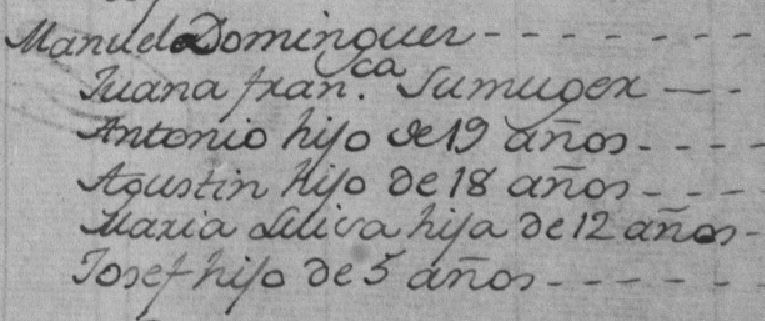
Manuel Dominguez & Juana Francisca Dominguez

Name: Manuel Dominguez
Ship: San Ignacio de Loyola
Birth: November 13, 1717 - Icod el Alto, Tenerife, Canary Islands, Spain
Father: Juan Dominguez
Mother: Maria Luis Hernandez

Wife: Juana Francisca Dominguez
Father: Felipe Francisco Moreno Hernandez
Mother: Clara Francisca Dominguez

DID: IL114

History

Manuel married Juana Francisca Dominguez, daughter of Felipe Francisco Hernandez and Clara Francisca Dominguez, on May 20, 1759 at Our Lady of the Conception in Realejo de Abajo, Tenerife.[7,16] Manuel and Juana were given a dispensation by the bishop in 1759 for the 4th degree consanguinity deriving from blood relatives in two ancestral lines.  His son Felipe Jacob, born may 14, 1764 died before the family left for Louisiana and was buried September 8, 1768 in Icod el Alto.

Manuel left Santa Cruz, Tenerife in 29 Oct 1778 sailing on the San Ignacio de Loyola and landed in New Orleans on Jan 9, 1779 with his wife Juana and children Antonio, Agustin, Maria, and Jose.[1]   He resided at the Barataria settlement.[4]  

San Ignacio de Loyola ship list
October 28, 1778
The Barataria settlers suffered great hardships and many requested to leave for other nearby Isleño settlements in Louisiana.  In 1782, the "libro" notes that this family was moved to the Valenzuela settlement.[4]  

Children

  1. Antonio Vicente (b. July 19, 1759)[5]
  2. Agustin Jose de la Concepcion (b. August 28, 1761)[6]
  3. Maria Luisa (b. May 9, 1767)[7]
  4. Jose Roberto (b. March 27, 1774)[8]
Son Antonio was born July 19, 1759 in Icod el Alto, Tenerife and baptized on July 29, 1759 at Our Lady of the Conception in Realejo de Abajo, Tenerife.[5]  He married Maria de Franques, daughter of Antonio de Franques and Margarita Perera.  They had children at the Valenzuela settlement.  He is listed in the 1782 and 1788, 1789, 1791, 1795, 1798 Spanish censuses of Lafourche.[10]  He died and was buried on November 1, 1807 in Plattenville.[12]   

Son Agustin was born August 28, 1761 in Icod el Alto, Tenerife and baptized on September 5, 1761 at Our Lady of the Conception in Realejo de Abajo, Tenerife.[6]  He married Lorenza Gonzales Carbo, daughter of Juan Francisco Gonzales Carbo and Andrea Augustina Ruiz.  They had children at the Valenzuela settlement.  He is listed in the 1782 and 1788, 1789, 1791, 1795, 1798 Spanish censuses of Lafourche.[10]   Agustin remarried Victorie Hebert, daughter of Pierre Hebert and Emelie Bourgeois, on May 14, 1807 at The Church of the Ascension of Our Lord Jesus Christ in Donaldsonville, Louisiana.11  He died and was buried in Plattenville, Louisiana on August 31, 1817.[9]  

Daughter Maria Luisa was born May 9, 1767 in Icod el Alto, Tenerife and baptized on May 24, 1767 at Our Lady of the Conception in Realejo de Abajo, Tenerife.[7]  She married Antonio Domingo Truxillo, son of Domingo Truxillo and Catalina Maria Dominguez of La Gomera, on August 30, 1784 at the Valenzuela settlement.[15]  They had children at the Valenzuela settlement.  She died September 27, 1833 and was buried on September 28, 1833 at the Assumption of the Blessed Virgin Mary Catholic Church at the Valenzuela settlement.[13]  

Son Jose was born March 27, 1774 in Icod el Alto, Tenerife and baptized on April 15, 1774 at Our Lady of the Conception in Realejo de Abajo, Tenerife.[8]    He died and was buried on February 23, 1811 in Donaldsonville.[14]   

References

  1. Gilbert C. Din, The Canary Islanders of Louisiana, Louisiana State University Press, p220, University of Louisiana at Lafayette Edith Garland Dupre Library, PO Box 40199, Lafayette LA 70504.
  2. Emilie G. Leumas, archivist, Diocese of Baton Rouge Catholic Church Records, Department of Archives, v2
  3. Emilie G. Leumas, archivist, Diocese of Baton Rouge Catholic Church Records, Department of Archives, v3
  4. "Libro Maestro P. sentar el cargo del dano. de la Pob. Barataria", Archivo General de Indias, Seville, (Papeles de Cuba, Legajo 2358)  Papeles de Cuba, Legajo 548, 84-44-L, Reel 92, Microfilm copy seen at The Historic New Orelans Collection (HNOC) in New Orleans, La.  Reprinted in Historic Land Use Study Of A Portion Of The Barataria Unit Of The Jean Lafitte National Historical Park by Betsy Swanson. Part 1. January 15, 1988.   Reprinted in Archeological Data Recovery Of The Camino Site (16JE223), A Spanish Colonial Period Site Near New Orleans, Louisiana. Report Number: COELMN/PD-96/01.  U.S. Army Corps of Engineers. New Orleans District. P.O. Box 60267. New Orleans, LA 70160-0267. March 1996.  p93-101.
  5. Parish Archives of Our Lady of the Conception, Realejo de Abajo, 8th Book of Baptisms, folio 57v
  6. Parish Archives of Our Lady of the Conception, Realejo de Abajo, 8th Book of Baptisms, folio 86.
  7. Parish Archives of Our Lady of the Conception, Realejo de Abajo, 8th Book of Baptisms, folio unknown.
  8. Parish Archives of Our Lady of the Conception, Realejo de Abajo, 9th Book of Baptisms, folio 101
  9. Emilie G. Leumas, archivist, Diocese of Baton Rouge Catholic Church Records, Department of Archives, v3, p271
  10. Papeles Procedentes de Cuba, Legajo 202.  Reprinted in Louisiana Census and Militia Lists, vol. I; Author: Robichaux, Jr., Albert J.; Publication: Polyanthos, 1977.
  11. Emilie G. Leumas, archivist, Diocese of Baton Rouge Catholic Church Records, Department of Archives, v3, p428
  12. Emilie G. Leumas, archivist, Diocese of Baton Rouge Catholic Church Records, Department of Archives, v3, p270
  13. Emilie G. Leumas, archivist, Diocese of Baton Rouge Catholic Church Records, Department of Archives, v5, p202
  14. Emilie G. Leumas, archivist, Diocese of Baton Rouge Catholic Church Records, Department of Archives, v3, p270
  15. Emilie G. Leumas, archivist, Diocese of Baton Rouge Catholic Church Records, Department of Archives, v2, p245
  16. Machado, Jose-Luis. Parroquia De La Concepcion Del Realejo Bajo: Libros De Los Mattrimonios De Los Anos 1583 A 1799.  Independently published (December 15, 2018).  p. 108

Sunday, January 29, 2023

Barataria Settlement (1778 - 1785)

Plano de Barataria, 1778

History[1] 

In 1779, the Spanish government established a settlement of immigrants from the Canary Islands along much of the length of both banks of Bayou des Familles and on Bayou Barataria near the confluence of the two bayous. The land for the new settlement was acquired by the government by purchase, through gift, and by repossession of unused lands. A 10-arpent-front by 110-arpent-deep tract of land, fronting Bayou Barataria between Bayou de la Borne and Bayou des Familles, was purchased by the King of Spain from Pedro Alberto Bonne prior to May 14, 1779. On that date, 'Bonne sold another 10-by-110-arpent strip bordering the King's on the west to Luis Pellerin. Two months later, Pellerin sold this strip to Andres Jung. Jung, who had been made Commandant of the Barataria Canary Islander settlement, donated the 10-arpent strip to the King of Spain on July 12, 1779. By this time, houses had been erected for the Islenos, and they were established on the property. The buildings were constructed by Joseph Chalon.

Considering that much of their depth consisted of cypress swamp, the two 10-arpent strips acquired by the King of Spain were not large enough for a poblacion. Therefore, the government repossessed lands that were vacant or disused for distribution to the lslenos. These lands adjoined the 20-arpent tract acquired by the Crown which gave important access to Bayou Barataria. Records indicate that the back lands of the Boudousquie, Guerbois and Dauterive properties were not occupied or used in the 1770s. The Spanish government reclaimed these and other lands along the bayou to a distance of 80 arpents from the river, which was the limit of the double concessions measuring 40 arpents each of the plantation properties fronting the river. The Canary Islander tracts formed one continuous settlement that stretched for seven aerial miles northward of Bayou Barataria along both sides of Bayou des Familles. This waterway had previously been known as Bayou Barataria and was renamed for the Spanish families that were settled along it.

The Canary Island immigrants were settled in Barataria as part of a Spanish program to populate remote areas of Louisiana with farmer-soldiers and their families, both for purposes of defense and to establish Spain's presence throughout the territory. This settlement program was developed as an outgrowth of revisions made by the Spanish government in the presidial concept of frontier defense. Because presidios were usually remotely located from sources of supply, they were frequently unable to sustain themselves without a supporting civilian population of farmers and ranchers, even at great cost to the royal treasury. Across New Spain's northern frontier, isolated presidios were pulled back and consolidated in the 1760s and 1770s. New regulations encouraged the colonization of new towns together with local militia companies. New presidios were laid out to include towns, cultivated fields, pasture, and woodland. 

In 1762, the Treaty of Fontainebleau ceded Louisiana from France to Spain. In 1763, the Treaty of Paris ceded Florida from Spain to England. With the exception of the Isle of Orleans, the eastern boundary of New Spain now lay on the westbank of the Mississippi River. The vast territory of Louisiana was the new Spanish frontier, and it entirely adjoined English territory. To help guard against encroachment by the English, Spain sought to people her new frontier with self-sustaining soldier-farmers loyal to Spain. The government-subsidized immigration of several thousand Canary Islanders was a part of this program. The program was not entirely successful and was a continuous drain on the royal treasury. The principal reason for lack of success was that the government selected settlement sites for their strategic defense value, rather than for their suitability for residence and agriculture. Many of the settlements failed after there were years of suffering and many deaths. 

As a route from the sea to New Orleans, it was important to guard Barataria against invasion. Fifty-seven Canary Islander families, consisting of about 250 persons, were settled there in 1779. They had sailed from Santa Cruz de Tenerife late in 1778 and early in 1779, in several ships. The government built houses for them and provided them with utensils, implements, firearms, a few animals, clothing, money, and rations. Each family was to receive at least five arpents of land fronting the bayou for farming and stock raising.

The Barataria Isleno settlement was devastated by hurricanes in 1779, 1780, 1793 and 1794, and by major flood in 1796 and 1802-4. Bayou des Familles was still partially fed from the Mississippi River at present-day Marrero, and there were frequent crevasses and floods. The Islenos' crops were repeatedly destroyed. Their animals were killed and their buildings were ruined. The government relocated some of the families and reestablished others in Barataria in successively fewer numbers. The poblacion was still being heavily provisioned by the government upon the death of Commandant Jung in 1784. A census of 1788 listed the "Pueblo" of Barataria as having a population of 40, 25 of whom were white. Five Barataria Isleno families, numbering 27 people, lost all their crops and animals in the 1796 crevasse. The crevasse of 1802 was not closed for two years, and most of the remaining Canary Islander families were relocated-on Bayou Terres aux Boeufs.

-----------------------------

NOTE:  There are two known migrations documented.  The first was before December 15, 1779 in which Lt. Antonio de St. Maxent, commandant of Valenzuela, escorted 16 families of Baratarians to his settlement.   The second migration occurred in September 1782 when 25 Baratarian families petitioned Pierre DeMarigny, commandant of St. Bernard, to allow them to move to his district. 

VAL = Known families to have left for the Valenzuela settlement in December 1779.
TAB = Known families to have left for the Terre-Aux-Boeuf settlement (St. Bernard) in September 1782.


Known Isleño Settlers of Barataria
The list is based on the libro maestro between of July 20, 1779 and 1784.[2]  

VAL = Moved to Valenzuela between 1782 and 1784
TAB = Moved to Terre-Aux-Boeuf after 1784

1 - Melchor Jimenez
Catalina Perdomo, his wife
Juan, son
Diego, son
Josefa, daughter
Francisco, son

2 - Jose Herrera
Lucia Gonzalez, his wife
Ignacio, son

3 - Juan Jimenez [VAL]
Juana (daughter)
Maria (daughter)

4 - Jose Hidalgo [VAL]
Isabel Zambrana, his wife
Gregoria, daughter
Francisca, daughter
Juan, son

5 - Lorenzo Hernandez [VAL]
Maria Jimenez, his wife
Ana, daughter
Maria, daughter

6 - Juan Cabrera
Lorenza Artiles, his wife
Juan, son
Francisco, son
Maria, daughter
Sebastiana, daughter

7 - Antonio Suarez
Juana Suarez, his wife
Francisco, son

8 - Pablo Ruiz
Maria Olivares, his wife
Juan, son

9 - Juan Alvarado [VAL]
Maria Suarez, his wife
Tomas, son
Isabel, sughter
Francisca Antonia, sister-in-law

10 - Jose Antonio Ventura
Antonia Pesos, his wife
Jose, son
Lorenza, daughter
Maria, daughter

11 - Lorenzo Rodriguez de Leon
Maria Espino, his wife
Luis, son
Antonio, son
Sebastiana, daughter

12 - Vicente Delgado
Felipa Jimenez, his wife
Isabel, daughter
Sebastiana, daughter

13 - Jose Dominguez
Maria Francisca, his wife
Felipa Dominguez, his mother
Fernando, son
Tomasa, daughter

14 - Juan Aleman [VAL]
Juana Ramirez, his wife
Antonio, son
Baltasar, son
Pedro, son
Josefa, daughter
Sebastiana, daughter

15 - Francisco Ramirez
Ana Perez, his wife
Francisco, son
Antonia, daughter

16 - Domingo Lopez [VAL]
Francisca, sister

17 - Antonio Martel
Francisca Antonia, his wife
Antonio, son
Domingo, son
Blasina, daughter

18 - Juan Espino
Joaquina Soler, his wife
Miguel, son

19 - Pedro Guedes
Isabel de Sosa, his wife
Sebastiana, daughter
Jose, son

20 - Manuel Ojeda
Francisca Medina, his wife
Juan, son
Maria, daughter

21 - Bartolome Hernandez Hidalgo [VAL]
Isabel Hidalgo, his wife

22 - Francisco de Orta
Josefa Lopez, his wife
Pedro, son
Antonia, daughter
Josefa, daughter
Isabel, daughter

23 - Gaspar Sanchez
Beatriz Flores, his wife
Ana, daughter
Cristobal, son
Francisco, son
Josefa Perez, sister-in-law

24 - Jose Hernandez Corvo
Beatriz Francisca, his wife
Salvador, son
Antonia, daughter
Francisco, son

25 - Gregorio Ojeda
Maria Suares, his wife
Maria, daughter
Josefa, daughter
Rosalia, daughter
Catalina Quintana (nursing infant)

26 - Cristobal Quintero
Maria Ruano, his wife
Cristobal, son
Maria, daughter
Beatriz, daughter

27 - Gregorio Judas Ravelo
Melchora de los Reyes, his wife
Jose', son
Maria, daughter

28 - Manuel Dominguez [VAL]
Juana Francisca, his wife
Antonio, son [VAL]
Agustin, son [VAL]
Maria Luisa, daughter
Jose, son

29 - Antonio de Fuentes
Marcela Perez, his wife
Juan, son
Francisco, son
Pedro, son
Jose', son
Ana, daughter

30 - Bartolome Monzon [VAL]
Maria Penales, his wife
Francisco, son
Isabel, daughter
Juana, daughter
Juan, son
Josefa, daughter

31 - Felipe Francisco
Bernarda Francisca, his wife
Domingo, son
Felipe, son
Jose, son
Lorenzo, son
Maria, daughter
Rosalia, daughter
Andrea, daughter

32 - Gaspar Ortiz Lopez
Maria Sanchez, his wife
Juan, son
Maria, daughter

33 - Agustin Romero
Polonia Rodriguez, his wife
Jose, son
Domingo, son
Juan, son
Agustin, son

34 - Matias Francisco

35 - Antonio Gonzalez
Rosalia Ortega, his wife
Jose, son
Francisco, son
Maria, daughter
Josefa Ortega, sister-in-law

36 - Bernardo Nieves
Maria Rodriguez, his wife
Juan, son
Brigida, daughter
Isabel, sister-in-law

37 - Domingo Vicente Morales
Gregoria Hidalgo, his wife 

38 - Francisco Lopez Machado [VAL]
Margarita Ramirez, his wife
Maria, daughter

39 - Francisco Sanchez
Maria Caballero, his wife
Juan, son
Francisco, son

40 - Gabriel Hernandez
Barbara Melian, his wife
Vicente, son
Felix, son

41 - Antonio Ramirez
Ana Santana, his wife

42 - Agustin Sanchez
Francisca Ortiz, his wife 

43 - Antonio Perez
Catalina Perez, his wife 
Nicolas, son
Maria, daughter

44 - Fernando Morales
Bernarda Gonzalez, his wife
Isidro, son
Fernando, son

45 - Antonio Jose de Armas
Marla Delgado, his wife
Domingo, son

46 - Pedro Caniles [TAB]
Sebastiana Moreno, his wife
Antonia, daughter
Juan, son
Maria, daughter
Catalina, daughter

47 - Bartolome Caballero
Maria Artiles, his wife
Diego, son
Antonio, son
Bartolome, son
Maria, daughter
Agustina, daughter
Andrea, daughter

48 - Jose Suarez
Francisca Rodriguez, his wife
Maria, daughter

49 - Felipe Artiles
Juana Jimenez, his wife
Juan, son
Antonio, son
Maria, daughter
Juan Cazorla, brother

50 - Juan Melian
Maria Ortiz, his wife

51 - Simon Casimiro
Catalina Gonzalez, his wife

52 - Juan Alonso Romero
Maria Jose, his wife
Juan, son
Francisco, son
Antonio, son
Rosalia, daughter
Andrea, daughter
Maria, daughter

53 - Mateo Henriquez [TAB?]
Josefa Velez, his wife
Felipe, son
Maria, daughter

54 - Miguel Suarez [VAL]
Maria de la Cruz, his wife
Domingo, son
Sebastian, son
Miguel, son

55 - Domingo Hiedra(?)

56 - Pedro Jose Caballero [VAL]
Ana Gonzalez, his wife
Andrea, daughter
Juana, daughter
Asuncion, son
Miguel, son
Josefa, mother-in-law

57 - Jose Suarez

References

  1. Historic Land Use Study Of A Portion Of The Barataria Unit Of The Jean Lafitte National Historical Park by Betsy Swanson. Part 1. January 15, 1988. 
  2. Libro Maestro p. sentar el cargo del dano. de la nueba Pob. Barataria (Archivo General de Indias, Papeles de Cuba, Legajo 2358).  Reprinted in Historic Land Use Study Of A Portion Of The Barataria Unit Of The Jean Lafitte National Historical Park by Betsy Swanson. Part 1. January 15, 1988.   Reprinted in Archeological Data Recovery Of The Camino Site (16JE223), A Spanish Colonial Period Site Near New Orleans, Louisiana. Report Number: COELMN/PD-96/01.  U.S. Army Corps of Engineers. New Orleans District. P.O. Box 60267. New Orleans, LA 70160-0267. March 1996.  p93-101.
  3. Passenger lists of  Canary Islanders sailing to Louisiana, 1778. Archivo General de Indeas, Audiencia de Santo Domingo, Legajo 2661.